
Step Counting Matters!
Step Counting: Why It Matters (and how to make it easy for teachers!)
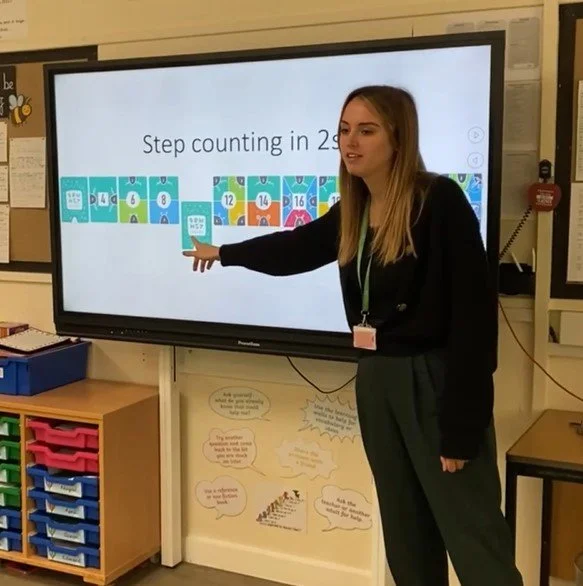
In my classroom, step counting popped up everywhere – morning maths, transitions, carpet time, warm-ups… and for good reason.
Step counting is one of those simple strategies that quietly does a huge amount of heavy lifting in children’s mathematical learning.
Step Counting with Year 2
Why We Should Spend Time Step Counting
At its heart, step counting helps children move away from counting one at a time and towards seeing numbers connected in other foundational patterns. Counting in 2s, 5s or 10s gives children a feel for how numbers grow, how sequences work and how multiplication actually behaves. It’s one of the earliest bridges between counting and times tables.
This is exactly why step counting is built into the National Curriculum in England and Wales. In Key Stage 1 (ages 5-7), children are expected to count in steps of 2, 3, 5 and 10. In Key Stage 2 (ages 7 -11) the curriculum requires children to learn to count in steps of 1 – 12. In too many schools, step counting is well embedded into the Key Stage 1 provision, but tails off as children get older. This is regrettable as strong step counting skills make such a difference later on – particularly when children are dealing with multiplication, division and fractions.
Why Step Counting Works So Well for Children
Step counting is accessible, inclusive and confidence-boosting. Everyone can join in – whether that’s chanting together, whisper-counting, clapping, stepping, pointing or tracking along visually. You’ll often see children who struggle with written work suddenly thriving when they can say the maths out loud and move with it.

Slide 1 on the PowerPoint for the 7x table. Seeing the multiples in context helps children see and remember connections.
The rhythms and repetition help children spot patterns and build fluency without it feeling like hard work. It’s also a brilliant way to reduce cognitive load. When children can confidently step count, they don’t need to stop and think about each number – they just know what comes next.
And let’s not forget how motivating that is. A whole class counting together, voices in unison, volume rising, smiles at the end – that sense of joining in and succeeding is powerful.
Making Step Counting Simple (and Enjoyable!)
Of course, fitting high-quality step counting into a busy school day isn’t always easy. Planning it, keeping it engaging and making sure everyone is involved can feel like another thing on an already long list.
That’s where the FunKey Maths Step Counting PowerPoints come in. They’re designed to be the easiest possible way to run step counting with a whole class. Just open them up and go. Regular 5-10 minute slots will make a huge difference in the long term.
The PowerPoints provide clear visuals for children to follow, making it easy to model counting together, pausing, repeating, speeding up or slowing down. Whether you’re using them as a quick starter, a daily routine or a transition activity, they help keep everyone focused and involved.
The PowerPoints are bright, interactive and genuinely fun, which means children want to join in. Teachers love the clear structure; pupils love the engaging approach. The result? Hands up, voices together, great participation – and step counting sessions that actually work.
Available to download
The FunKey Maths Step Counting PowerPoints are now available in the FunKey Maths shop, offering a simple, effective way to make step counting a confident, consistent part of your maths classroom. You won’t ever have to sticky notes for your counting stick again!
Go on, treat yourself to an easier life, and a bit of useful fun! Head over to our e-shop.
Want to see how simple it is to use the powerpoints? Download the teacher guidance here.